Silicon solar modules have gotten dramatically cheaper, which has shifted where the real cost of a solar system comes from. Today, the levelised cost of electricity (LCOE) is driven less by the module itself and more by everything around it, inverters, mounting structures, and installation, most of which scale with area. That makes higher cell efficiency the simplest lever left for cutting costs, which is why the industry has raced toward new, higher-efficiency cell architectures.
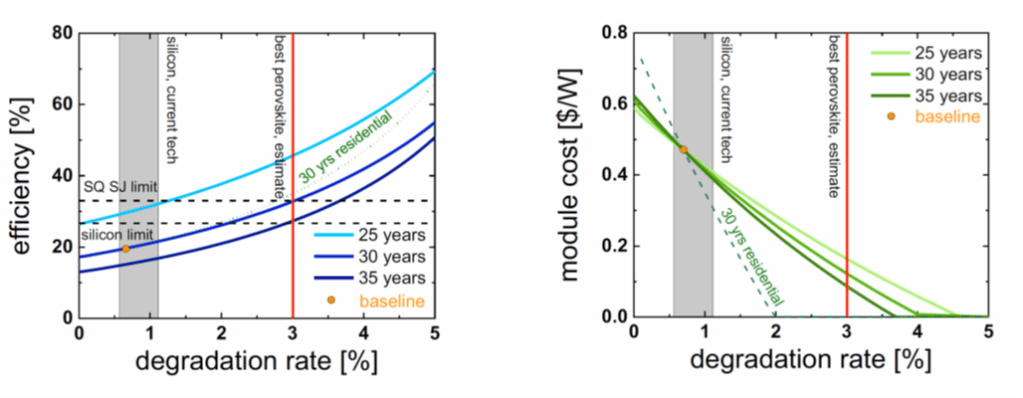
But there’s a catch. As Peters et al. showed, any gain from higher efficiency disappears quickly if the cell degrades faster over its lifetime [1, 2]. A silicon panel starting at a modest 20% efficiency with a slow 0.6%/year degradation rate can match the lifetime LCOE of a panel starting at an unrealistic 70% efficiency but degrading at 5%/year, assuming a 25-year lifetime and constant module costs. In other words: a small increase in degradation rate can erase a large efficiency advantage. This is why understanding and preventing degradation matters just as much as chasing efficiency records.
The new generation of high-efficiency cells
Passivating contact solar cells have pushed efficiency records well past what was possible with older PERC technology. The two leading architectures are:
- TOPCon (Tunnel Oxide Passivated Contact) — now the dominant technology in new manufacturing capacity worldwide, with lab/industrial-scale records reaching 26.7% and commercial cell records as high as 27.8% as of late 2025 [3, 4].
- Silicon heterojunction (SHJ) — the highest-efficiency single-junction silicon technology in production, with recent lab records around 27% and excellent temperature stability [5].
Both rely on nanoscale passivation layers, doped amorphous silicon or polysilicon on thin oxides, to suppress losses at the cell surface. They’re also increasingly seen as the foundation (“bottom cell”) for silicon-based tandem devices. Perovskite-silicon tandems have already broken the long-standing theoretical ceiling for single-junction silicon (the 33.7% Shockley-Queisser limit), with certified results as high as 34.85% [6]. Even so, perovskite stability remains the key barrier to commercialisation.
This is exactly the pattern from Figure 1: exciting efficiency numbers mean little if the underlying stability isn’t there.
What real-world testing tells us
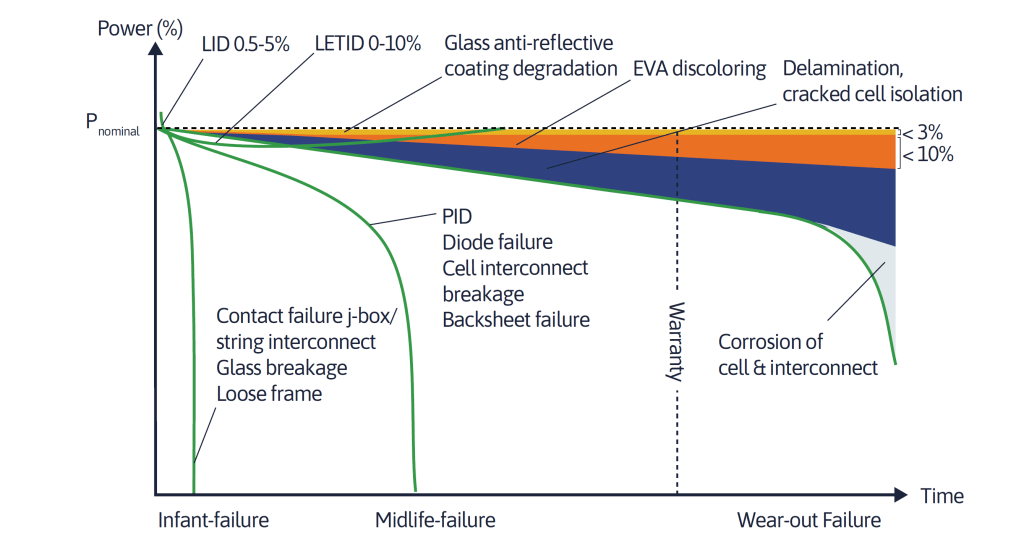
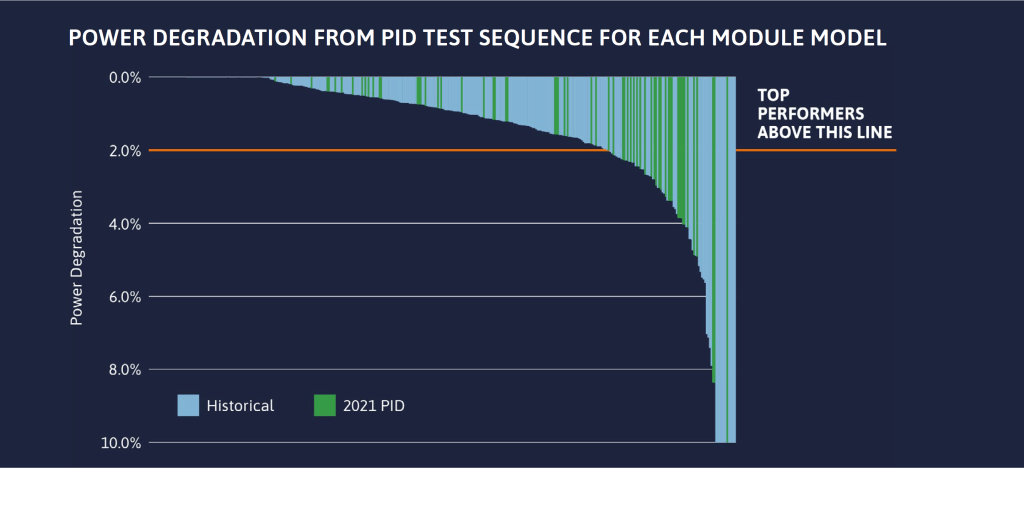
Figure 2 shows data from PV Evolution Labs (PVEL), a leading independent reliability testing lab for the solar industry. Because PVEL tests commercial, end-use products rather than lab prototypes, its data is a good proxy for what’s actually installed in the field. A multi-year PVEL dataset found that even modules explicitly labelled “PID resistant” showed their worst potential-induced degradation (PID) results in the most recent testing year,a reminder that manufacturer labels don’t always match real-world performance.
More recent PVEL data specifically on TOPCon modules reinforces this: across nearly 400 modules tested for UV-induced degradation, losses ranged from under 1% to over 16%, with a median around 3%, proof that UV stability, like PID resistance, varies enormously between manufacturers even within the same cell technology [8].
The failure modes we investigate
Our group focuses on the degradation mechanisms most relevant to today’s passivating contact cells. We’ve developed rapid tests for each — often orders of magnitude faster than standard qualification tests — alongside practical mitigation strategies.
Surface-related degradation (SRD)
A slow degradation process that becomes more severe in the lightly doped surfaces typical of TOPCon contacts. We’ve found that SRD scales with firing temperature and is thermally activated, pointing to hydrogen as the underlying cause. We use that understanding to both detect it faster and mitigate it [9, 10].

Potential-induced degradation (PID)
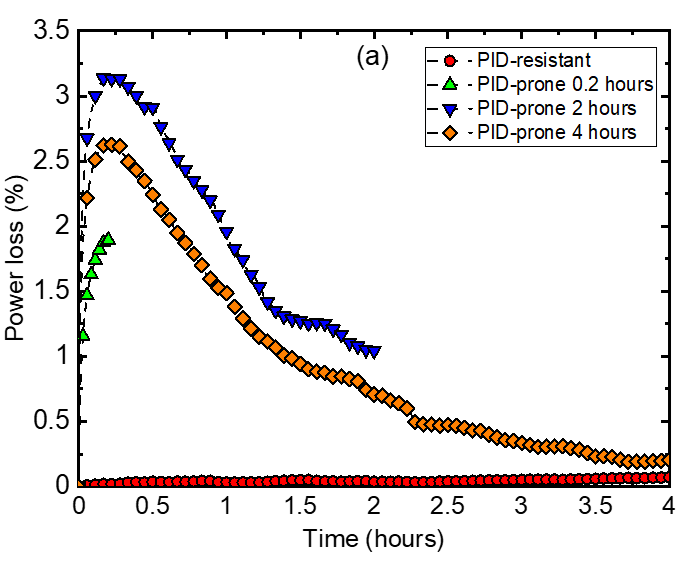
PID has made an unwelcome comeback in modern modules, partly due to the shift to bifacial cells, which exposes both surfaces to the failure mode. We’ve developed a rapid PID test that applies salt to the cell surface before stress testing, detecting PID-prone cells in under 30 minutes — and shown that atomic-layer-deposited films can block PID-related shunting by acting as a diffusion barrier [11, 12].
Damp-heat degradation
Our recent work found that unencapsulated heterojunction cells degrade significantly more than PERC cells under damp-heat testing. We’ve since extended this work to full glass-backsheet modules, examining whether TOPCon cells are compatible with standard EVA encapsulation under damp-heat stress — with results that have direct implications for module bill-of-materials decisions [13, 14, 15].

UV-induced degradation (UVID)
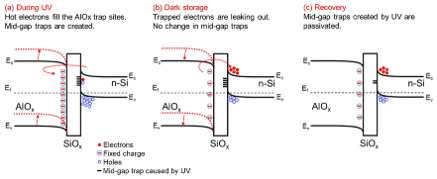
UVID has emerged as a major reliability concern for both TOPCon and SHJ cells, and is now a core focus of the group. We’re investigating the hydrogen dynamics behind UVID and how different UV wavelengths affect the degradation rate — work that underpins a new joint research initiative with RAYZON Solar (India) to study and mitigate UVID in TOPCon cells as part of the India–Australia Renewable Energy Partnership [16, 17].
Radiation-induced degradation
We also work on making solar cells resistant to space radiation [18].
References
- Peters, I.M., et al., The Value of Efficiency in Photovoltaics. Joule, 2019, 3(11): 2732–2747. https://doi.org/10.1016/j.joule.2019.07.028
- Peters, I.M., et al., The value of stability in photovoltaics. Joule, 2021, 5(12): 3137–3153. https://doi.org/10.1016/j.joule.2021.10.019
- Yang, Z., et al., Dual-side electrical refinement enables efficient industrial tunnel oxide passivating contact silicon solar cells. Nature Energy, 2026. https://doi.org/10.1038/s41560-026-01982-2
- JinkoSolar, 27.79% efficiency TOPCon world record, December 2025. (Manufacturer announcement — no DOI available.)
- Xie, Z.G., et al., 27%-efficiency silicon heterojunction cell with 98.6% cell-to-module ratio driving new momentum towards the 29.4% limit. Nature Communications, 2025, 16(1): 9421. https://doi.org/10.1038/s41467-025-64465-0
- LONGi, 34.85% NREL-certified perovskite-silicon tandem cell, April 2025. (Manufacturer/NREL announcement — no DOI available.)
- PVEL, PV Module Reliability Scorecard. https://modulescorecard.pvel.com/ (Industry report — no DOI available.)
- PVEL, 2024–2025 UVID dataset (as reported in industry field-performance analyses, 2026). (Industry dataset — no DOI available.)
- Sen, C., et al., Impact of surface doping profile and passivation layers on surface-related degradation in silicon PERC solar cells. Solar Energy Materials and Solar Cells, 2022, 235. https://doi.org/10.1016/j.solmat.2021.111497
- Chen, D., et al., Investigating the degradation behaviours of n(+)-doped Poly-Si passivation layers. Solar Energy Materials and Solar Cells, 2022, 236: 9. https://doi.org/10.1016/j.solmat.2021.111491
- Khan, M.U., et al., Supercharging cell-level potential-induced degradation (PID) testing using a salt-enriched hybrid polymer layer. Solar Energy Materials and Solar Cells, 2023, 260. https://doi.org/10.1016/j.solmat.2023.112479
- Sen, C., et al., Four failure modes in silicon heterojunction glass-backsheet modules. Solar Energy Materials and Solar Cells, 2023, 257. https://doi.org/10.1016/j.solmat.2023.112358
- Wu, X., et al., Unveiling the degradation mechanisms in silicon heterojunction solar cells under accelerated damp-heat testing. Solar Energy Materials and Solar Cells, 2025, 282. https://doi.org/10.1016/j.solmat.2024.113325
- Wu, X., et al., Is TOPCon ready for EVA? Insights from damp heat testing of glass-backsheet modules. Solar Energy Materials and Solar Cells, 2025, 288. https://doi.org/10.1016/j.solmat.2025.113650
- IEA PVPS Task 13, Degradation and Failure Modes in New Photovoltaic Cell and Module Technologies, 2025. https://www.iea-pvps.org/wp-content/uploads/2025/02/IEA-PVPS-T13-30-2025-EX-SUMM-Degradation-and-Failure.pdf (Report — no DOI available.)
- Khan, M.U., et al., UV-induced degradation in TOPCon solar cells: Hydrogen dynamics and impact of UV wavelength. Solar Energy Materials and Solar Cells, 2026, 294. https://doi.org/10.1016/j.solmat.2025.113895
- Energetica India, RAYZON Solar and UNSW Lead India–Australia Initiative to Tackle UV Degradation in TOPCon Cells, November 2025. https://www.energetica-india.net/news/rayzon-solar-and-unsw-lead-indiaaustralia-initiative-to-tackle-uv-degradation-in-topcon-cells (News article — no DOI available.)
- Li, G., et al., Electron radiation-induced degradation of silicon solar cells. Solar Energy Materials and Solar Cells, 2026, 296: 114062. https://doi.org/10.1016/j.solmat.2025.114062

