Tunnel oxide passivated contact (TOPCon) cells have become the dominant architecture in the silicon photovoltaic market, prized for their high efficiency and compatibility with existing manufacturing lines. As TOPCon modules are deployed at scale for 25–30 year field lifetimes, however, a more difficult question has emerged: how well do these cells hold up once moisture, heat, and the trace chemistry of real-world modules start acting on them? Our group’s damp-heat and reliability research shows that corrosion of the metal contacts, the encapsulant-facing passivation layers, and the interfaces between them is one of the central factors limiting TOPCon’s long-term stability.
Why TOPCon is corrosion-prone
The damp-heat (DH) test, in which modules are held at 85 °C and 85% relative humidity for up to several thousand hours, is the standard accelerated stress test used to probe field-relevant degradation. Repeated testing across our group and others shows that TOPCon’s front screen-printed silver contact is disproportionately sensitive to DH exposure compared with the rear side and compared with older PERC technology.[1,2] The root cause is structural: screen-printed and fired silver contacts are inherently porous, leaving open pathways for moisture and dissolved contaminants to reach the metal–silicon interface.[1,2,3]
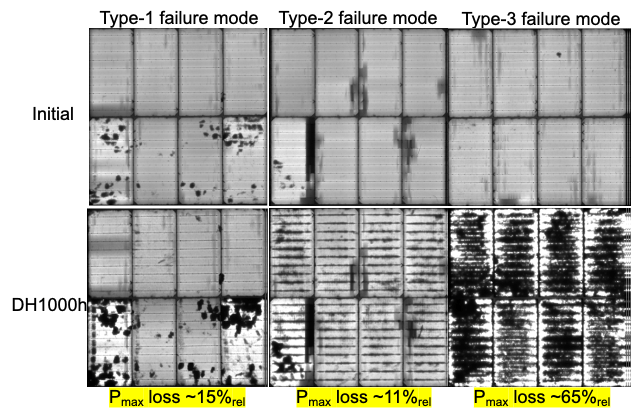
Once moisture is present, several corrosive chemistries can take hold. Acetic acid — generated when EVA encapsulant hydrolyses under heat and humidity — readily dissolves the lead oxide (PbO) in the glass frit that binds silver fingers to the silicon surface, causing the metal to lose electrical and mechanical contact with the cell.[4] Chloride and sodium ions, whether introduced from soda-lime cover glass or from environmental exposure to dust, seawater spray, or rainwater, drive a similar corrosive attack and have been shown to cause TOPCon front-contact power losses of up to ~75% relative after just 20 hours of accelerated DH testing.[4] Residues left behind by soldering flux during module assembly add a further contamination source, penetrating the porous contact structure and accelerating electrode degradation even before a module has spent a single day in the field.[6,7]
Beyond the metal contact: passivation-layer corrosion
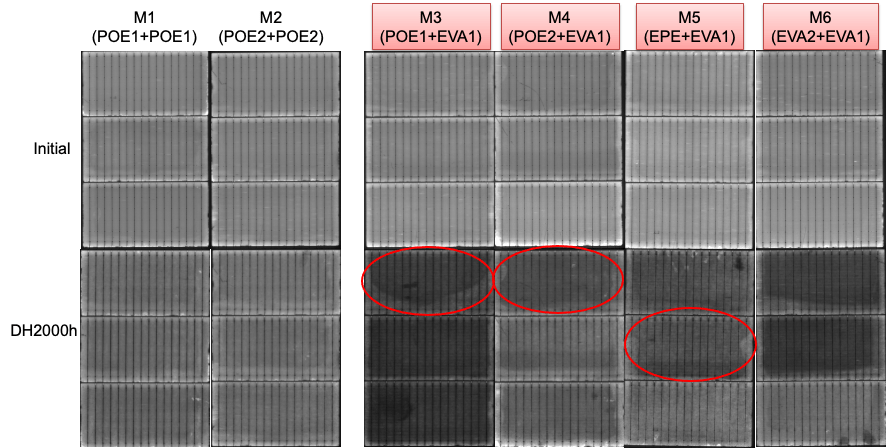
Corrosion in TOPCon modules is not confined to the metal grid. Our group recently identified a previously unreported degradation pathway in which magnesium (Mg) additives present in certain white EVA encapsulant formulations hydrate under damp-heat conditions to create a localised alkaline micro-environment. This alkaline attack corrodes the rear SiNx:H passivation layer directly, depassivating interfacial dangling bonds and creating pinhole-like recombination shunts, increasing rear recombinatino, and reducing open-circuit voltage even in regions with no metal contact nearby.[8] This finding shows that encapsulant chemistry, not just contact porosity, needs to be considered when designing corrosion-resistant TOPCon modules.
Mitigation strategies
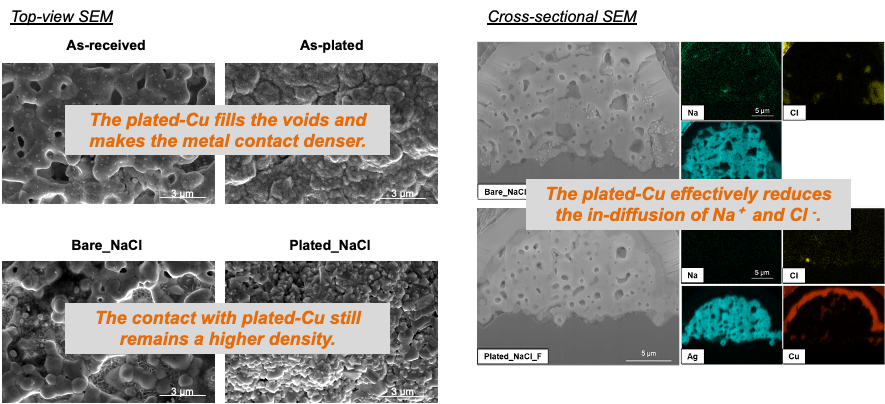
Because the underlying driver is ingress through a porous contact, one effective countermeasure is to seal it. Our work has shown that light-induced, bias-assisted copper plating of the front silver grid forms a dense capping layer that fills the residual voids left by screen printing, substantially suppressing NaCl-induced corrosion during accelerated DH testing without requiring any change to the paste or firing process.[9] Complementary strategies identified across our reliability studies include using low- or Al-free silver pastes enabled by laser-assisted firing, selecting encapsulants with low acetic-acid generation potential (e.g. POE/TPO over standard EVA) and controlled Mg content, and optimising soldering flux chemistry to minimise corrosive residues during module assembly. Together, these approaches target each stage of the degradation pathway, from contact porosity to encapsulant hydrolysis to flux-related contamination, and point towards manufacturing strategies that preserve TOPCon’s efficiency advantage while closing the reliability gap with more mature technologies.
References
- Buyer aware: Three new failure modes in TOPCon modules absent from PERC technology, Chandany Sen, Haoran Wang, Muhammad Umair Khan, Jiexi Fu, Xinyuan Wu, Xutao Wang, Bram Hoex, Solar Energy Materials and Solar Cells 272,112877, https://doi.org/10.1016/j.solmat.2024.112877
- Sen, C., Wang, H., Heidrich, R., Lüdemann, M., Khan, M. U., & Hoex, B. (2026). The dark side of certain POE encapsulant: Chemical pathways to metallisation corrosion in TOPCon modules. Solar Energy Materials and Solar Cells, 298, 114164. doi.org/10.1016/j.solmat.2026.114164
- H. Tong, X. Wu, X. Wang, X. Xu, M. Guo, B. Liao, S. Ma, Z. Li, B. Hoex (2025). Mitigating contaminant-induced surface degradation in TOPCon solar cells: Mechanisms, impacts, and mitigation. Solar Energy Materials and Solar Cells, 286, 113558. doi.org/10.1016/j.solmat.2025.113558
- Fu, J., Sen, C., Wang, H., Khan, M. U., Song, H., Lv, R., Huang, T., & Hoex, B. (2026). Assessing the impact of solder flux-induced corrosion on TOPCon solar cells. Solar Energy Materials and Solar Cells, 294, 113890. doi.org/10.1016/j.solmat.2025.113890
- Sen, C., Wu, X., Wang, H., Khan, M. U., Mao, L., Jiang, F., Xu, T., Zhang, G., Chan, C., & Hoex, B. (2023). Accelerated damp-heat testing at the cell-level of bifacial silicon HJT, PERC and TOPCon solar cells using sodium chloride. Solar Energy Materials and Solar Cells, 262, 112554. doi.org/10.1016/j.solmat.2023.112554
- Fu, J., Sen, C., Wang, H., Khan, M. U., Song, H., Lv, R., Huang, T., & Hoex, B. (2026). Assessing the impact of solder flux-induced corrosion on TOPCon solar cells. Solar Energy Materials and Solar Cells, 294, 113890. doi.org/10.1016/j.solmat.2025.113890
- Wang, H., Sen, C., Fu, J., Khan, M. U., Song, H., Lv, R., Conibeer, G., & Hoex, B. (2025). The Influence of Soldering Flux on Stability of Heterojunction and TOPCon Solar Cells. Progress in Photovoltaics: Research and Applications. doi.org/10.1002/pip.3896
- A novel damp heat-induced failure mechanism in PV modules (with case study in TOPCon), Haoran Wang, Chandany Sen, Muhammad Umair Khan, Ting Huang, Hao Song, Munan Gao, Ruirui Lv, Yuanjie Yu, Bram Hoex, Solar Energy Materials and Solar Cells, Vol. 299, 114195 (2026). http://dx.doi.org/10.1016/j.rser.2017.04.080
- X. Wang, C. Sen, X. Wu, Y.-C. Chang, H. Wang, M. U. Khan, B. Hoex (2025). Alleviating contaminant-induced degradation of TOPCon solar cells with copper plating. Solar Energy Materials and Solar Cells, 282, 113444. doi.org/10.1016/j.solmat.2025.113444

